How to Vet a Scalp Micropigmentation Artist
Check the register before the Instagram. Whether a scalp micropigmentation artist is allowed to work on you at all is a legal question with a different answer in almost every country, and in the United States a different answer in almost every county — and it is the one check you can complete without anyone's cooperation.
Everything after that is about evidence: healed work rather than day-one photographs, written terms rather than reassurance, and an artist who will tell you what the procedure cannot do.
Start with the register, not the portfolio
The rules are genuinely different depending on where you stand. In the United States the Food and Drug Administration regulates the ink as a cosmetic but states that the actual practice of tattooing is regulated by local jurisdictions — so the register you need is a state or county one, not a federal list.
In England and Wales, Part VIII of the Local Government (Miscellaneous Provisions) Act 1982 requires that a person carrying on the business of tattooing or of semi-permanent skin-colouring be registered by the local authority, that the premises be registered too, and that the authority issue a certificate. Ask to see the certificate. It is a hygiene and premises registration rather than a test of artistry, which is exactly why it is a floor and not a recommendation.
In South Korea the procedure is restricted by law to licensed medical professionals — and a 2025 survey of 131 dermatology outpatients with hair loss in Annals of Dermatology found that while 65.6% knew the rule, every one of the five respondents who had actually had SMP done had it done in a non-medical setting. Knowing where the line is and staying on the right side of it turn out to be different things, for patients as well as practitioners.
What the correction studies say about where it went wrong
There is one useful study on this and it is worth reading carefully rather than quoting loosely. A 2025 retrospective review in the International Journal of Dermatology looked at 120 patients who came for correction after unsatisfactory scalp micropigmentation, and recorded where the original work had been done: 89.2% at a tattooing or cosmetic facility at a beauty salon performing permanent makeup, 10.0% at another clinic, and one patient at an oriental-medicine clinic.
The corrections themselves were substantial. 61.7% of those patients were treated with hair transplant surgery to cover the tattoo; 20.8% had surgery plus fresh pigment; 13.3% had laser tattoo removal followed by new SMP; and 4.2% had the pigment removed and left it there. Reported satisfaction after correction was high — 4.5 out of 5 from patients, 4.6 from the physician.
Now the caveats, because they decide what the study is good for. It is retrospective, from a single centre, in one country, with no comparison group and no denominator. It cannot tell you how often SMP goes wrong, and it is not evidence that salon work fails more often than clinic work — it is a count of who turned up at one clinic to have something put right. What it does show is that correcting a scalp tattoo is frequently a surgical undertaking, not a touch-up.
When it goes wrong
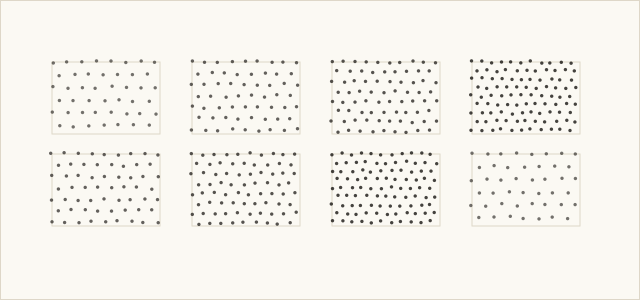
120 people who went back to have SMP put right
Every dot is one patient in the retrospective review published in the International Journal of Dermatology (2025), which looked at 120 people who sought correction after scalp micropigmentation. It is a single-centre series in South Korea with no comparison group, so it says nothing about how often SMP needs correcting — only what correcting it involved for these 120.
Questions worth asking before you book
- Are you registered, and with whom? Ask for the certificate or licence number and check it yourself with the issuing authority.
- Can I see healed work at six months or later, in ordinary light? Anyone can photograph a scalp on the day it is done.
- How many sessions are you quoting, and what happens if it needs more? The published range is two to four sessions; get the price of a fifth before you start.
- What is your touch-up interval and what does one cost? Nobody can tell you a published figure, so what you want is their policy in writing.
- What pigment do you use, and what happens to it as it ages? An artist who says “it never changes” is telling you they have not looked.
- Where would you refuse to draw the hairline I am asking for? The right answer involves the word no.
- What can this not fix? If nothing on that list, walk.
Healed work, not day-one photographs
A fresh plate is at its darkest and sharpest the moment it is finished, and it is not what you are buying. You are buying what it looks like once the swelling has gone, the scabbing has cleared and the first fade has happened — which the one published measurement puts inside six months.
Ask specifically for images taken months after a final session, on a head you can see in ordinary daylight, at a normal distance and up close. The published trichoscopy work is a useful reality check here: a 2022 paper in Skin Appendage Disorders describes SMP under magnification as evenly spaced circular dots that are visibly larger than the follicles beside them. Any portfolio that pretends otherwise at close range is being photographed generously.
Hygiene is a checklist, not an atmosphere
The regulator's concerns are specific and you can ask about all of them. The FDA's tattoo fact sheet lists infection from unsterile equipment and needles — including HIV, hepatitis and Staphylococcus aureus — and notes that infections have also come from contaminated inks even where the artist followed hygienic procedure.
Single-use needles opened in front of you, ink from a sealed source, documented sterilisation, and a premises registration you have actually seen. The same page also mentions a practical consequence worth knowing: a tattoo done at a facility your state does not regulate, or one re-using ink, may keep you out of blood or plasma donation for twelve months.
Red flags
- A price that only exists today. Urgency is a sales technique, and this is a decision with a laser at the other end of it.
- No written touch-up policy. The one thing every source agrees on is that touch-ups happen.
- Promises about permanence, comfort or guaranteed results. Nobody can promise any of the three, and the literature contradicts the first.
- No registration to show. In England and Wales that is not a preference, it is the law; elsewhere, find out what your local rule is first.
- Reluctance to talk about removal. An artist who cannot discuss what happens if you hate it has not thought about you hating it.
- A diagnosis offered across a consultation desk. Hair loss is diagnosed by a doctor or dermatologist, and a studio saying otherwise is outside its lane.
The wider version of this decision — what the procedure is, what it cannot do and what the regulator says about tattooed skin — is in the full guide to scalp micropigmentation. If the thing you are really worried about is what happens afterwards, start with the regrets note.
Questions about choosing an artist
Is there an SMP qualification I can check?
Should I choose a clinic over a studio?
How many sessions should an artist quote?
What if the work is already bad?
The long version of all of this sits on what scalp micropigmentation actually is, and what it costs is picked apart on the scalp micropigmentation cost page. Neither page names a studio, and neither is a substitute for a doctor looking at your scalp.
Read next

SMP Aftercare: What the Sources Say, and Who to Ask
Your artist's written instructions are the authority, not a website. What the regulator and the published literature do say about freshly tattooed skin, sun, infection and when something has gone wrong.

What HairClub's Free Consultation Actually Involves
A measurement, a report and a sales conversation — plus a sentence on HairClub's own page that tells you what the appointment is not. What to bring and what to get in writing.