Sources read September 2026 · not medical advice
Scalp micropigmentation, examined dot by dot
A cosmetic tattoo that makes a thinning scalp read as stubble. Here is how a plate is built, who is legally allowed to build one, what the regulator says about tattooed skin, what fades, and what it takes to get it out again.
On this page
Scalp micropigmentation is a cosmetic tattoo of the scalp: pigment placed in the upper dermis as thousands of separate dots, arranged so that from conversational distance they read as hair follicles cropped very short. It adds no hair. What it changes is contrast — the difference in tone between bare scalp and whatever hair is still there — and contrast is most of what makes thinning visible.
That sentence is the whole subject, and the rest of this page is its consequences: how a plate is built, who is legally allowed to build one, what the pigment does over time, what the regulator says tattoos do to skin, and what happens when you want it gone. None of it is medical advice and none of it is a recommendation of a person or a place.
What scalp micropigmentation actually is
It is a tattoo, and the published literature treats it as one. A 2022 clinicopathologic paper in Skin Appendage Disorders describes SMP as depositing pigment between hair follicles in a stippling pattern that resembles closely cut hair, and notes what it looks like under magnification: homogeneous, grey-to-black circular dots, evenly spaced, that appear larger than adjacent hair follicles. In other words, close up the illusion stops working. It is built for the distance people actually stand at.
The technique is not new and it did not begin with hairlines. The 2016 camouflage review in the International Journal of Women's Dermatology traces scalp micropigmentation back to camouflaging scalp scars, and describes the procedure as inserting pigment through the skin into the upper dermis using conventional tattoo instruments, with the artistry sitting in the judgement about where each dot goes.
Commercial descriptions say the same thing when you read them closely. HairClub's own page for the treatment states that it creates the appearance of natural hair follicles using pigments placed within the scalp, and then, plainly: the procedure does not grow new hair. It says the effect comes from reducing the contrast between scalp and existing hair. That is an honest description of camouflage, and it is worth holding onto when you read a studio's page that avoids saying it.
What happens across a three-session plate
Expect more than one appointment. The 2016 review puts completion at approximately two to four sessions, each lasting up to eight hours; HairClub says most of its own SMP work is completed over two to four sessions. Nobody credible describes it as a single afternoon.
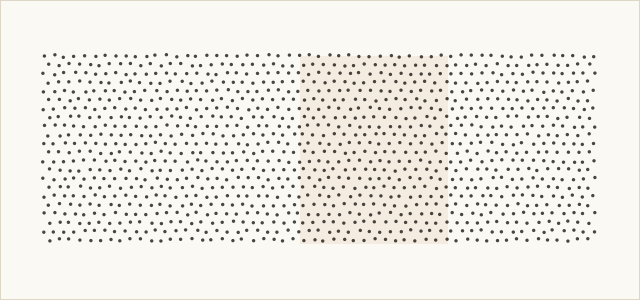
What changes between sessions is density. The most detailed published protocol is a small 2025 case series in the Journal of Cosmetic Dermatology, which used a standardised three-session approach and stepped pigment density up deliberately: 30% of natural follicular spacing on the first pass, 70% on the second, then 100% of natural follicular spacing on the third. The point of building up is that you cannot take dots out again, so the artist under-fills first and judges the result once it has healed.
The same series describes the technical variables the artist is actually controlling: needle choice for each zone, deliberately randomised dot placement so the field does not look mechanical, and a working depth shallow enough to avoid bleeding. A 2017 paper in the Journal of Cutaneous and Aesthetic Surgery lists a longer set — needle angle, depth, contact time, rotor speed, scalp resistance, pigment colour, ink viscosity, needle thickness and dot pattern — every one of which is a decision, not a setting.
There is no machine that gets this right on its own, which is exactly why the question of who is holding it matters more than the brand of it.
How a plate is built
Three passes, each one denser than the last
Drawn from the standardised three-session protocol described in the ten-patient case series in the Journal of Cosmetic Dermatology (2025), which stepped pigment density from 30% to 70% to 100% of natural follicular spacing. Ten patients is a very small series, and density is the artist's judgement, not a setting on a machine.
Who is allowed to hold the needle
It depends entirely on where you are, and the range is wider than most people expect. In the United States the FDA regulates the ink as a cosmetic but states that the actual practice of tattooing is regulated by local jurisdictions — so the answer is set by your state or county, not nationally.
In England and Wales the requirement is registration, not qualification. Part VIII of the Local Government (Miscellaneous Provisions) Act 1982 makes it an offence to carry on the business of tattooing or of semi-permanent skin-colouring — defined in the Act as the insertion of semi-permanent colouring into a person's skin — unless the person is registered by the local authority, and unless the premises are registered too. The authority registers the individual and the address and issues a certificate. Nothing in that scheme tests whether the person can design a hairline.
South Korea sits at the other end: the procedure is legally restricted there to licensed medical professionals. A 2025 survey of 131 dermatology outpatients with hair loss in Annals of Dermatology found 65.6% of them knew that — and that all five respondents who had actually had SMP done had it done in a non-medical setting anyway. Knowing the rule and following it turned out to be two different things.
No other country's position was checked for this page, and rules change. Look up your own local authority or health department before you book, and ask the studio to show you its registration.
Who is allowed to do this
Three places, three different answers
Read at source on 24 September 2026: the FDA's tattoo and permanent makeup fact sheet; Part VIII, section 15 of the Local Government (Miscellaneous Provisions) Act 1982 on legislation.gov.uk; and the South Korean position as described in the 2025 patient survey in Annals of Dermatology. No other country was checked, and rules change.
What it cannot do
It cannot grow hair, slow hair loss, or protect the hair you still have. Every published description of the technique is a description of camouflage, and the loss underneath carries on at its own pace. That has a practical edge: the 2016 review notes that work may need touch-ups over time both because pigment fades and because hair loss progresses, which means a plate designed around today's coverage can be wrong about next year's.
It cannot survive close inspection as hair, because it is not hair — under a trichoscope the dots are visibly bigger than the follicles around them. It cannot restore a hairline you have outgrown either: a hairline drawn too low or too hard at thirty is a tattoo you still own at fifty.
And it cannot be undone cheaply. That is the trade the whole decision turns on, and it is covered further down.
How the cosmetic routes compare
Four honest options sit side by side, and the cheapest to reverse is the cheapest to try. The table below compares what each one does, what it costs where a price is actually published, and what it costs you to change your mind.
| Route | What it does | Published price | Undoing it | The catch |
|---|---|---|---|---|
| Scalp micropigmentation | Dots of pigment in the upper dermis; lowers the contrast between scalp and hair | Not published — set per studio | Laser, several sessions, sometimes incomplete | Two to four long sessions; the design outlives your face |
| Hair system or wig | A made base carrying hair, taped, bonded or clipped to the scalp | A 2016 review published $60–$2,000 by build; current prices not published | Take it off | Adhesives cause contact dermatitis in some wearers; maintenance never stops |
| Keratin fibres and powders | Charged keratin particles that cling to hair already on the head | $9.95 to $79.95 at Toppik, read 24 Sep 2026 | Shampoo | Useless on bald skin — the fibres need hair to hold onto; reapplied daily |
| Clipping it short and doing nothing | Removes the contrast by removing the hair | The price of clippers | Grow it back | Costs nothing, pays this site nothing, and suits more people than the industry admits |
Read that last row seriously. A short, even clip across the whole scalp attacks exactly the same variable SMP attacks — contrast — for the price of a set of clippers, with nothing to reverse. It is the only route on this page that nobody profits from, which is roughly why you have to go looking for it.
The risks the FDA lists
These are the regulator's, not this site's. The FDA's tattoo and permanent-makeup fact sheet sets out the primary complications of tattooing:
- Infection. Unsterile equipment and needles can transmit HIV, hepatitis and skin infections including Staphylococcus aureus. Infections have also come from contaminated inks even where the artist followed hygienic procedures.
- Removal problems. Removal is painstaking, usually takes several treatments and considerable expense, and complete removal without scarring may be impossible.
- Allergic reactions. Rare for tattoo pigments, but troublesome when they happen because the pigment is hard to remove — and a reaction can begin years later.
- Granulomas, nodules forming around pigment the body treats as foreign.
- Keloid formation, if you are prone to keloids. The FDA also cites a textbook finding that keloids occur more frequently as a consequence of tattoo removal.
There is an MRI footnote worth knowing rather than worrying about. The FDA records reports of swelling or burning in tattooed areas during an MRI, rarely and apparently without lasting effects, and reports of pigment degrading image quality. Its advice is not to skip the scan — the risk of avoiding a scan your doctor wants is the larger one — but to tell the radiographer you have scalp pigment.
One more practical note from the same page: a tattoo done at a facility your state does not regulate, or one re-using ink, may keep you out of blood or plasma donation for twelve months.
Fading, blurring and the touch-up nobody can date
Pigment moves and dulls, and the honest answer about how fast is that nobody has measured it properly. The FDA's fact sheet says tattoos sometimes fade, and that pigment injected too deeply can migrate beyond the original dots and leave a blurred look — which on a scalp plate is the difference between stubble and a smudge.
The only measurement this site could find is small. That 2025 ten-patient series scored visual density at 8.7 out of 10 straight after treatment and 7.7 at six months, with scarring alopecia fading further than pattern hair loss. Ten people, one team, half a year: it is a signal that fading is real and early, not a rate you can plan a decade around.
Colour drift has a second cause that has nothing to do with the ink. The 2016 review points out that natural hair greys over time, so the surrounding hair may need dyeing to keep matching pigment that is not changing at all. Ask any artist what their touch-up interval is, get it in writing, and treat a studio that promises none with suspicion.
If you change your mind
Removal is possible, slow and not guaranteed to be complete. The FDA's consumer update on tattoo removal describes laser treatment as the usual method, requiring multiple sessions weeks apart, with hypopigmentation, scarring, infection, bleeding, redness and soreness among the risks — and it is explicit that complete removal may not be possible.
Colour decides a lot of it, and the FDA puts the order plainly: “Colors such as green, red, and yellow are the hardest colors to remove, while dark blue and black are the easiest.” Flesh-toned tattoos, white ink and permanent makeup are the awkward cases, because those pigments can oxidize — turn black — under laser light, and oxidized pigment is no longer treatable by laser at all. Scalp work is usually black or grey, which is the good news in that list.
Published experience specific to SMP is thin but encouraging at small scale: a 2020 case series in Lasers in Surgery and Medicine cleared unwanted SMP in four patients within one to three sessions using a 1064 nm picosecond laser. Four patients is four patients. And there is a 2026 report in Dermatologic Surgery whose title alone tells you what can happen on the way: colour change first, then complete removal, across multiple laser wavelengths.
The creams do not work. The FDA has approved no tattoo-removal ointment, cream or do-it-yourself kit, says it has seen no evidence any of them are safe or effective, and notes they can cause rashes, burns and scars.
Getting it out again
Which inks the laser can reach
Ordered from the US Food and Drug Administration's consumer update on tattoo removal (fda.gov, page current as of 3 August 2023): dark blue and black are the easiest for a laser to break up, green, red and yellow the hardest, and flesh-toned, white and permanent-makeup pigments can oxidize to black, after which the laser cannot treat them at all.
Before you book anything
Get the diagnosis first. Thinning that turns out to be thyroid disease, iron deficiency, alopecia areata, a scarring alopecia or a drug side effect is a medical problem wearing a cosmetic disguise, and tattooing over it changes nothing underneath — it may also make the scalp harder to read for whoever examines it later.
Then check the person. Ask for the local registration or licence, ask what happens if the colour drifts, ask who does the touch-ups and at what price, and ask to see healed work rather than work photographed on the day. If you want the longer version of that conversation, it is in how to vet an SMP artist, and the money side is picked apart on what scalp micropigmentation costs.
Questions people ask about SMP
Is scalp micropigmentation painful?
Can scalp micropigmentation cover a hair transplant scar?
Will it look right if I grow my hair out later?
Does scalp micropigmentation stop hair loss?
How do I check an artist is registered?
Paid link. It carries rel="sponsored nofollow" and pays this site if you go on to buy or book. HairClub sells scalp micropigmentation alongside surgery, systems and regrowth programmes across the US and Canada, and its own site says it is not a clinic and cannot diagnose anything. Seeing a dermatologist first pays this site nothing, and is still the better first move.