Scalp Micropigmentation for Women: A Different Job
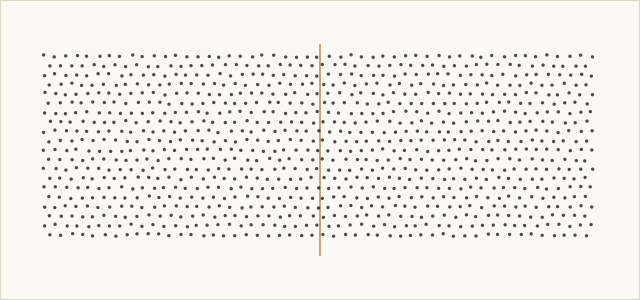
Scalp micropigmentation for women is usually a different job from the one the phrase brings to mind. The shaved-head plate — dots standing in for stubble across a whole scalp — is not what most women are asking for. The common request is density: pigment placed between the hairs that are still there, along a part that has widened, to stop the scalp showing through so brightly.
That difference changes what the technique is doing, what it depends on, and who it suits. It also makes getting a diagnosis first more important, not less.
Diagnosis is not optional here
Hair loss in women has a longer list of causes than pattern loss, and several of them are treatable, reversible, or signs of something else: thyroid disease, iron deficiency, telogen effluvium after illness or childbirth, alopecia areata, medication effects, and scarring alopecias that destroy follicles permanently. Pigment placed over an undiagnosed scalp changes nothing underneath and can make the scalp harder for a doctor to read afterwards.
So the sequence is a doctor or board-certified dermatologist first, cosmetic decisions second. That visit pays this site nothing, which is exactly why it belongs at the top of the page rather than the bottom.
What the pigment is doing differently
On a closely cropped head, the dots replace hair. On a thinning part, they sit between hairs and darken the skin showing through, so the eye reads density where there is really contrast. HairClub describes the same mechanism for diffuse thinning in both men and women: reducing visible scalp show-through to make hair look fuller without surgery.
Because the effect depends on hair that is still there, how much is left matters more than it does on a shaved plate. And because long hair moves, parts shift and light gets through differently depending on how it is worn, the result is less controllable than it is on stubble.
The one published attempt at a rule
A 2024 retrospective study in the Journal of Cosmetic Dermatology reviewed 40 women with female pattern hair loss who had been treated either with a hair transplant (23 of them) or with micropigmentation (17), measuring hair density and follicular unit density at the part line and mid-occiput with a Folliscope.
Hair density turned out to be the factor that separated the groups. The authors propose micropigmentation where density is at or above 104.6 hairs per square centimetre, and strongly recommend transplant surgery at or below 96.17. The logic is intuitive: the more hair remains, the more there is for pigment to work between.
Forty patients, one centre, looking backwards at treatment that had already been chosen — this is a proposal for clinicians with measuring equipment, not a number to apply to yourself. Quoted here because it is the only published attempt at a rule, and because it shows the decision turning on measurement rather than on preference.
Scarring alopecia fades faster
One finding is worth flagging for anyone whose hair loss involves scarring. The 2025 ten-patient case series in the Journal of Cosmetic Dermatology measured visual density immediately after treatment and again at six months, and the drop was larger in the scarring-alopecia patients than in the pattern-hair-loss ones. Scar tissue takes and holds pigment differently.
Published work also describes SMP being used to camouflage cicatricial alopecia specifically, including a 2026 report in Dermatologic Surgery on lichen planopilaris. That is a real use with a real evidence base — and a reason to expect a different touch-up conversation from the standard one. The wider fading picture is in the regrets note.
Long hair complicates everything
Pigment is fixed and hair is not. A plate designed for a part worn on one side is being looked at from a different angle the day you part it on the other; hair pulled back exposes a different area of scalp than hair worn down. None of that is a reason not to do it, but it is a reason to talk through how you actually wear your hair — and to be wary of a design that assumes one style forever.
Hair systems and toppers solve the same problem by adding hair rather than darkening skin, and they come off at night. Both of those routes are compared in hair systems explained.
Before booking anything
- Get a diagnosis. Female hair loss has causes that pigment cannot touch and a doctor can.
- Ask how the artist works on thinning rather than shaved scalps. They are different skills and not everyone does both.
- Talk about how you wear your hair, including on the days you wear it differently.
- Ask what fades faster on your scalp specifically — especially if any of the loss involves scarring.
- Check the register where you live before anything else. Who may legally do this varies by country and, in the United States, by local jurisdiction.
Shaved plates for women, and when they make sense
The full shaved look is a smaller share of the requests, but it is not a men-only option. Women who already keep their hair very short, and women with extensive loss where there is little left for pigment to work between, are in the situation the technique was originally built for — the dots stand in for stubble rather than filling gaps.
It is a bigger aesthetic commitment and the same permanence applies. A plate drawn for a closely cropped head does not disappear if you later decide to grow hair out or wear a wig over it: the field sits there under whatever you put on top. The honest version of that conversation happens before the first session, not after the third.
What a consultation should actually cover
Whatever you are being offered, a consultation that only discusses the result is half a consultation. The other half is what happens afterwards, and it is the half that gets skipped.
- Where the hairline goes, and why not lower. A soft, irregular front edge ages better than a sharp one, and an artist who talks you down from what you asked for is doing the job.
- How the plate behaves as the loss progresses, given that it will.
- The touch-up policy in writing — price, who does it, and what counts as a touch-up rather than a new session.
- What happens if you hate it, said out loud, before you agree to anything.
- Whether they have worked on your kind of hair loss before, particularly if any of it involves scarring.
The full account of what the procedure is, what the regulator says about tattooed skin and what removal involves is on the scalp micropigmentation guide.
Questions from women considering SMP
Does SMP work on a widening part?
Will SMP damage the hair I still have?
Is SMP suitable for alopecia areata?
Can I still dye my hair afterwards?
The long version of all of this sits on what scalp micropigmentation actually is, and what it costs is picked apart on the scalp micropigmentation cost page. Neither page names a studio, and neither is a substitute for a doctor looking at your scalp.
Read next
SMP Aftercare: What the Sources Say, and Who to Ask
Your artist's written instructions are the authority, not a website. What the regulator and the published literature do say about freshly tattooed skin, sun, infection and when something has gone wrong.
What HairClub's Free Consultation Actually Involves
A measurement, a report and a sales conversation — plus a sentence on HairClub's own page that tells you what the appointment is not. What to bring and what to get in writing.