Hair Fibres and Concealers: What They Do, and Where They Fail
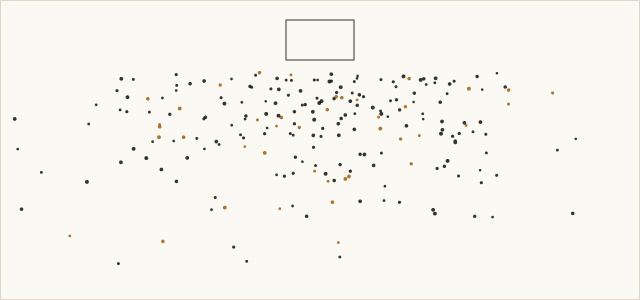
Hair building fibres are coloured keratin powder that clings to the hair you still have, thickening each strand's apparent width and darkening the scalp showing between them. They are the cheapest, fastest and most reversible answer to the same problem scalp micropigmentation attacks, and they have one absolute limitation that decides whether they are any use to you.
This is the only product on this site with a score attached, because it is the only subject here that is a consumer product with a published price and a published mechanism rather than a procedure performed by a person.
How they actually work
The mechanism is electrostatic and it is described independently, not just by the people selling it. The 2016 camouflage review in the International Journal of Women's Dermatology describes topical hair fibres as positively charged particles of wool keratin that adhere to the negatively charged terminal and vellus hair fibres on the scalp. Fibres, it adds, are derived from wool or rice keratin, rayon or human hair.
Toppik, which that review names as a popular brand, describes its own product as made of coloured keratin protein. The two descriptions agree, which is rarer than it should be in this category.
The effect is two things at once: each existing hair looks thicker because it is carrying powder, and the scalp behind it looks darker because powder has landed there too. That second half is the same contrast trick a density plate of pigment performs permanently.
The limitation that decides it
They need hair. The 2016 review states it flatly: this product requires existing hairs to bind; therefore, this option is ineffective in bald areas. No amount of powder sticks to bare skin, and a fully bald crown is not a place fibres can help.
That single sentence sorts the audience. If there is hair — thinning, fine, receding at the temples, widening at the part — fibres are worth a fortnight before anything permanent. If the area is bare, they are not the product and no marketing photograph changes that.
The same review adds that fibres must be applied daily, which is the other half of the trade: you are buying a nightly routine, not a result.
What they cost, to the cent
Unlike almost everything else in this subject, this is checkable. Toppik's own shop, read on 24 September 2026, lists Hair Building Fibers at $24.95 for the Regular 12 g bottle, $46.95 for Economy 27.5 g and $79.95 for Giant 55 g; the Hair Fibers Starter Set, which pairs a 12 g bottle with a spray applicator and a hairline optimizer, at $34.95; Colored Hair Thickener at $19.95; FiberHold Spray at $9.95; and the Hairline Optimizer alone at $4.95. US dollars, before tax and shipping, on the day they were read.
Two things to note from the same catalogue. The range has been trimmed: Toppik's own product note says Auburn, Light Blonde and Medium Blonde are no longer available in the Giant or Economy sizes, and White, Gray and Light Brown are no longer available in Giant. And the site carries a 30-day money-back guarantee banner, which is worth reading in full on their terms rather than trusting a banner.
Compare that to the pigment route, where no studio publishes a price at all. The contrast is the subject of what scalp micropigmentation costs.
Powders, sprays and lotions are not the same product
Fibres are one of several concealers and the differences matter. The 2016 review describes powder cakes as circular concealing disks applied to the scalp with a sponge and then brushed through; the material is water resistant but removed with shampoo. Camouflage lotions and sprays, it says, are applied to limit the colour contrast between existing hair and scalp.
The advantages it lists apply across the group: easy to remove, workable with various hair colours and styles, and usable alongside medical therapy. So are the drawbacks: daily application, and the fact that water activities may distort the product. Sprays and lotions colour the scalp directly rather than clinging to hair, which means they can do something on an area where fibres cannot.
Where this route honestly sits
It is the trial version. Spending a month with a bottle tells you whether reducing the contrast between scalp and hair is actually the thing that bothers you, for less than the price of a consultation and with nothing to undo. People who find it transformative have learned something real about what they want; people who find it fiddly and unconvincing have learned something equally real, and cheaply.
Nobody should be talked out of that experiment by someone selling a tattoo. The full account of the permanent version, including what it takes to remove it, is in the guide to scalp micropigmentation.
Questions about fibres and concealers
Do hair fibres work on a bald head?
Do hair fibres damage hair?
How long do hair fibres last on the head?
Can I use fibres after a hair transplant or SMP session?
Paid link. It carries rel="sponsored nofollow" and pays this site if you go on to buy or book. Toppik makes the keratin fibres priced above, and its prices are quoted here because they are published and checkable. Fibres do nothing on skin with no hair left on it, and a month with a bottle costs less than a consultation.
The long version of all of this sits on what scalp micropigmentation actually is, and what it costs is picked apart on the scalp micropigmentation cost page. Neither page names a studio, and neither is a substitute for a doctor looking at your scalp.
Read next
SMP Aftercare: What the Sources Say, and Who to Ask
Your artist's written instructions are the authority, not a website. What the regulator and the published literature do say about freshly tattooed skin, sun, infection and when something has gone wrong.
What HairClub's Free Consultation Actually Involves
A measurement, a report and a sales conversation — plus a sentence on HairClub's own page that tells you what the appointment is not. What to bring and what to get in writing.