SMP Over Transplant Scars: The Oldest Use of the Technique
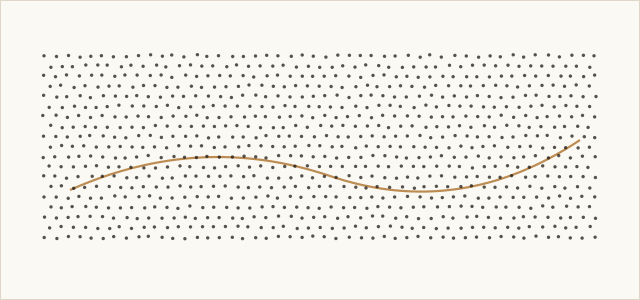
Covering a scalp scar is the oldest documented use of this technique and the one with the longest paper trail. The 2016 camouflage review in the International Journal of Women's Dermatology traces scalp micropigmentation back to a 2001 report on using micropigmentation specifically for scalp scars, years before anyone was drawing hairlines with it.
That history matters because it changes the expectation. Scar camouflage is not asking pigment to imitate a whole head of stubble. It is asking it to make one stripe of pale, textured skin stop announcing itself among the hair around it.
What a strip scar and a punch-scar field actually look like
Transplant surgery leaves two recognisable kinds of mark, and they are different problems. Follicular unit strip surgery separates grafts from a linear strip of donor scalp and leaves a linear scar behind it; follicular unit extraction uses small punches instead, which the same review describes as avoiding the wide linear scar.
So one is a line and the other is a scatter of small pale dots. Pigment addresses both the same way — by reducing the contrast between the mark and the scalp around it — but the design problem differs: a line needs its edges broken up, a punch field needs matching to the stippling that is already there by accident.
Neither is being removed. The scar is still a scar; it is being made harder to pick out.
Scarred skin takes pigment differently
This is the finding most worth carrying into a consultation. The 2025 ten-patient case series in the Journal of Cosmetic Dermatology included four patients with scarring alopecia alongside six with androgenetic alopecia, and measured visual density immediately after treatment and again at six months.
Both groups faded. The scarring group faded more — a drop of 1.6 points against 0.9 for the pattern-hair-loss group, a difference the authors report as statistically significant. Ten patients is a very small study, but the mechanism is not surprising: scar tissue is structurally different skin, and it holds ink differently.
The practical read is that a scar plate should come with its own touch-up expectation rather than the studio's standard one. Ask about it specifically. The general picture on fading is in the regrets note.
Published use goes beyond transplant scars
The literature on micropigmentation over damaged scalp is broader than surgical scars. A 2014 study in Aesthetic Plastic Surgery examined micropigmentation for camouflaging scalp alopecia and scars in 43 Korean patients — all with black hair, so only black pigment was used — and reported that one patient was dissatisfied and no complications occurred.
More recently, a 2026 report in Dermatologic Surgery describes scalp micropigmentation used for camouflage of cicatricial alopecia from lichen planopilaris, and published work exists on combining follicular unit extraction with micropigmentation in the cosmetic treatment of alopecias. A 2026 case report in the Journal of Clinical Medicine even includes scalp micropigmentation in a multi-stage reconstruction after catastrophic burn injury.
These are case reports and small series, not trials, and every one of them was performed by people who do this professionally in a medical setting. They establish that the use is real and documented, not that it will work on a given scar.
What has to happen before anyone tattoos a scar
- The scar must be mature and settled. A scalp still healing is not a surface to make a permanent decision on, and only the person who operated or a doctor examining it can say when it is ready.
- Someone medical should look at it. Scarring alopecias are a diagnosis, not a texture, and some of them are active conditions that go on destroying follicles under whatever you put on top.
- Ask about keloid history. The FDA lists keloid formation among the risks of tattooing for people prone to them, and cites a textbook finding that keloids occur more frequently as a consequence of tattoo removal.
- Ask how the artist handles the transition. The hard part is not the scar, it is the edge where the plate meets untouched scalp.
- Expect a different fade. The one published measurement says scar tissue lost more density at six months than pattern-loss scalp did.
It is not the only way scars get camouflaged
Two cheaper and entirely reversible options do a version of the same job, and neither gets mentioned much because neither is a booking. Keratin fibres cling to hair around a scar and reduce how sharply it stands out — with the documented limitation that they need hair to bind to and, as a 2016 review puts it, are ineffective in bald areas, which includes most scar tissue itself. A hairpiece covers the area entirely and comes off at night.
Neither is a good long-term answer for someone who keeps their hair clipped short, which is exactly the group that asks about scar camouflage most. But both are worth a month before a permanent decision, and both are compared in hair fibres and concealers and hair systems explained.
It is still a tattoo, on skin that has already been through something
All the usual risks apply, and the FDA lists them plainly for tattooing in general: infection from unsterile equipment or contaminated ink, allergic reactions that can be particularly troublesome because pigment is hard to remove, granulomas forming around pigment the body treats as foreign, and keloid formation in people prone to it.
Removal, if it comes to that, is the same slow process as anywhere else on a scalp: several laser sessions, risks including scarring and hypopigmentation, and no guarantee of complete clearance. Putting pigment into a scar you may later want removed is a decision with two difficult surfaces in it rather than one, which is a reason to have the conversation with a dermatologist rather than only with a studio.
The full account of the procedure, the regulator's list and what removal involves is in the guide to scalp micropigmentation, and the question of who should be holding the needle is in how to vet an SMP artist.
Questions about SMP on scars
Can SMP completely hide a strip scar?
How long does SMP last on a scar?
Does SMP hurt more over scar tissue?
Can SMP be done over a scar that is still healing?
The long version of all of this sits on what scalp micropigmentation actually is, and what it costs is picked apart on the scalp micropigmentation cost page. Neither page names a studio, and neither is a substitute for a doctor looking at your scalp.
Read next

SMP Aftercare: What the Sources Say, and Who to Ask
Your artist's written instructions are the authority, not a website. What the regulator and the published literature do say about freshly tattooed skin, sun, infection and when something has gone wrong.
What HairClub's Free Consultation Actually Involves
A measurement, a report and a sales conversation — plus a sentence on HairClub's own page that tells you what the appointment is not. What to bring and what to get in writing.